 Selling services online is another great way to make money online if you don’t mind dedicating the time and effort required to make it work.
The definition of selling services online, is just that. The satisfactory performance of some service that your client requires from you. Basically, it is freelance work that your employer or client requires you to perform.
Some examples of services include graphic designing, programming, consulting, web site building, copy writing, ghost writing anything from press releases to ebooks, and even building backlinks for SEO.
A lot of money can be made by selling services online, which is precisely why so many people are doing it.
It’s not unusual for good copywriters to get $40,000 or more for writing one letter, and for marketing consultants who only meet once a month or so, to get paid $10,000 or more per month to discuss marketing strategies with their clients.
If you are a professional in your field, it’s not out of the realm for you to earn a six or seven figure income selling services online.
Unlike selling physical or digital products; the nice thing about selling services online, in addition to the fact that you can rake in a hefty income, is that you get paid up front before doing any real work.
Selling physical or digital products usually requires an initial investment to prepare your product for sale, which is not needed when selling services online.
However, there are downsides to selling services online that you need to know.
- The main con is that you must approach selling services online like you would a 9 to 5 job.
You’re trading your time and expertise for dollars. This means you give up the flexibility and freedom that you have when selling physical or digital products online.
Because your clients expect you to provide results within a promised date and time frame, and in order to maintain your credibility and good standing; you must give up the freedom that other online business models provide.
You can’t set selling services online on autopilot, like you can do with digital or physical products.
- Another con to selling services online, is the occasionally “hard to please” client.
Although most of your clients will probably be totally satisfied with the quality of your work, you will occasionally come across clients that are “difficult” and “impossible to please”.
Not only can these clients can make your life miserable, they make it not worth the time you invested for the amount of money you received for doing the job.
You can circumvent dealing directly with unhappy clients, by hiring staff to deal with them.
- This is a great way to remove yourself from the picture, however then you become the “boss” and must deal with additional problems that a business “office” environment entails.
You have to pay your staff, deal with all the government small business bureaucracies, and become the business office manager.
If losing some flexibility and freedom doesn’t present a problem for you and if your personality and goals are directed towards this type business model; then selling services online is for you.

If you want to really stand out from the crowd; optimizing your videos is essential to video marketing and is something you must to learn to do.
 Anyone can learn how to create a compelling video for their YouTube audience without needing to spend a ton of cash on fancy technology.
YouTube makes it simple for even a novice to create a great video and easily upload it; but optimizing your videos is necessary to get your audience to view them over the hundreds of thousands that are already online.
Because YouTube only allows you about ten minutes to make a good impression; you need to make the best possible use of that time to get your video viewed and to send your message out to your audience.
There are features that make videos appeal to viewers, as well as features that make videos unappealing.
So how do you know the good vs. bad features of a video?
The best way is to RATE your video.
The last time you watched a movie preview, was it intriguing? Did the video make you want it to not end? Did the video nudge you into asking questions?
You should be asking yourself these type questions, and be thinking along these lines, as you create your videos.
Create your very own movie preview and ask yourself these questions to make sure your goals are met when creating your video.
- Did you get your message out to your audience?
- Did your video make your point?
- Did your video make viewers want to come back to see more?
- Did your video provide a well recorded audio track and clear shots?
- Did you make your video short, sweet, and focused?
- Did you use graphics to improve your video and keep your viewers engaged?
- Did you optimize your video?
You need to record a dynamic sharp video, that is anything but ordinary, in under ten minutes that will capture and hold your audience.
If you don’t think you can noodle a creative topic for your video, you had better put on your thinking cap and think again!
Most of the wildly popular videos on YouTube are popular because the producer came up with something “off the wall” and did something totally interesting and unique. They were thinking “out of the box” to make their videos different from everyone else online.
Here is a simple way to help you brainstorm an idea for your video.
- Write down on a piece of paper or your computer Notepad, ten of the best ideas you can come up with for making a great video.
- Then, write down what makes each idea appealing next to each idea you came up with.
- If you don’t have at least five reasons for a compelling idea for each of your “best ideas”, remove it from your list.
- Next, trim down your list to your top five choices.
- Decide how you are going to present the content in your video.
- How will you highlight your video to make it unique and unusual?
Will you wear makeup? Will you add a Lady GaGa sound track? Will you record your video while skydiving?
Regardless of what you come up with as you are optimizing your videos, you need to make sure it is something totally “off the wall” and unique.
Remember that people turn to YouTube to find interesting and unique things to view; they can always watch their television if they want something boring.
Nobody wants to watch an infomercial or commercials on YouTube.
So, if you are trying to brand or promote your website; be careful to do it in a way that is innovative, creative, and fun to watch.
Optimizing your videos is more than just throwing up some keywords on YouTube; it’s about all of the above!
This article will show how to research and target keywords using free tools that are available from Google.
First you need to understand that targeted keywords generate qualified traffic.
Ranking for relevant keywords is much more important than focusing on scoring tons of traffic that may or may not convert well on your web site.
There are two free tools available in the Opportunities section of Google AdWords, and two advanced search tools that are available in the left sidebar of the Search Engine Results Page that are extremely useful in finding relevant keywords.
Oh, and did I forget to mention that they are all FREE?
 Google’s Wonder Wheel is an amazing free service that allows you to easily refine the more popular and very competitive keywords, to come up with relevant longtail keywords for your search engine marketing.
The Wonder Wheel is located in the left column of the search engine results page, and is extremely easy to use to harvest potentially useful long tailed keywords.
Under the “more tools” section, you can also find Related Searches and Timelines, that can be used to narrow down your keywords.
Google’s AdWords Keyword Tool and Traffic Estimator are both available in the Opportunities section of Google Adwords.
The Google AdWords Keyword Tool is used to do additional research on the list of keywords that you generated from the Google Wonder Wheel tool.
With the Keyword Tool, you can get a general idea of the amount of traffic and the level of competition that a keyword has on Google; and either keep, or discard the more competitive keywords.
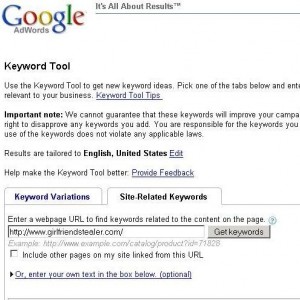
Google AdWords Keyword gives you the ability to go through your preliminary list of keywords and identify which keywords receive the most competition. It also identifies keywords that receive far less traffic than what is desired. Essentially, the tool functions like a micro keyword finder.
Like the Google Wonder Wheel, the Google AdWords Keyword Tool also does an excellent job of generating relevant targeted keywords.
When you have learned how to research and target keywords using free tools from Google, don’t forget to study the search engine results page, to determine whether it’s possible for you to easily rank with the keyword you have finally settled on.


