
Building Natural Back-links
We all know that outside of some “black hat” techniques, directory submissions are one of the most popular methods of generating back-links to your website in the shortest amount of time.
When you create your back link campaigns, building natural back-links using directory submissions that look normal to the search engines is extremely important.
The search engines should see a natural progression of increased back links to your site; not a sudden deluge of links that have little relevancy to your niche topic.
You risk being penalized or losing your current position in the search engine results if your back links look unnatural to Google and the other search engines.
The best way to eliminate the possibility of being penalized by the search engines is to adhere to the following suggestions when building directory back links.
The best approach to take when building natural back-links using directory submissions, is to gradually increase the number of featured links in each directory.
Use targeted keywords in your listing title as well as your listing description but most of all, be sure you list your site in the most relevant directory category.
The best way to list your site in directories is to do it manually however, it is a tedious and time consuming process.
You can save a lot of time and money by using one of the many software programs that automatically submit your website to the major directories, but only if the software program allows you to customize the description, title, keywords, anchor text you use in your listing and the number of directories submitted to.
None of the directory submitters will automate the submission process 100% but they will all reduce the amount of time it takes to make individual submissions.
One of the problems with automated software programs is that they mass submit your site to hundreds or even thousands of directories at one time.
This presents a big RED flag to the major search engines when they see a sudden influx of back-links to your site in a short time period.
If this should happen, your website could be flagged for review by Google and penalized.
Building natural back-links using directory submitters can be done without fear of reprisal if the software allows you full control of the directory submission process.
You MUST be able to control the number of directories that your website will be submitted to.
You must also be able to control how your site is submitted.
The better directory submitters filter through the directories that offer no link backs and let you choose from the number of directories submitted, in order to achieve one way inbound links.
Here are some tips for building natural back-links using directory submissions.
- When submitting to directories focus on one way back links.
Internal links in your site should always be more than your external links. In addition, you should always have more links coming into your website than going out.
- ALWAYS choose the category or sub category that is closest to the main directory level.
The closer the category is that to the top level directory that you submit your website to, the greater the exposure you will receive.
For example:
If your website is focused on “resumes preparation” and you have the following categories available for your website: Employment > Jobs > Resumes > Interviews >
the best subcategory to list your site that is closest to the top level would be
“Jobs”.
Even though “Resumes” appears more descriptive; the “Jobs” sub-category is closer to the main directory.
- Avoid mass directory submissions.
When building natural back-links, keep your focus on submitting your website correctly to a maximum of 100 directories at one time.
Mass directory submissions to hundreds or thousands of directories at one time will only flag your site for review by the search engines.
An inordinate number of one way links to your website looks unnatural, especially if it is a brand new site.
Think about it. When Google discovers that your brand new website is suddenly receiving thousands of generic back links, what would you think?
- Describe your website accurately.
Make sure you provide a relevant description of your website that includes your primary keywords that focus on your target market niche with every submission you make.
Don’t overdo using your keywords in your description. Placing your primary keyword in the title and at least once in the beginning of your description is enough for the search engines to take note.
- Use a good directory submission software program.
If you decide not to manually submit your website to the online directories and opt to use a software program; make sure you can manipulate the number of directories submitted to and customize the programs parameters to suit your requirements.
Building natural back-links using directory submissions is something that everyone can achieve when done correctly.
The following directory resources are a good start for building natural back-links.
Top 100 Free Directory List
List of Niche Directories
SEO Friendly Directory

Do Pligg site article submissions really increase site traffic?

Pligg site article submissions
In case you haven’t heard the term before; Pligg is an Open Source Web 2.0 CMS for social publishing of content that combines bookmarking, social networking, and blogging.
Pligg sites are very similar to Digg, where the site visitors are the creators, consumers and judges of the content.
Every news item that is submitted has a vote button, a URL and a short item description where visitors can vote and/or comment on the submissions.
At the end of the day, the vote count determines if items are either automatically promoted to the home page, held in a queue, or permanently deleted from the site.
Pligg sites are routinely used for article submissions, blog postings, websites, content, etc. In essence they are “mini article directories”.
Plig site submissions get indexed just as quickly as the content on Squidoo, HubPages and other authority sites like these.
Because of this and other factors, Plugg sites are often used for Search Engine Optimization and promotion of websites.
Although traditional article marketing works, it is no longer enough.
Because of the number of people that are already using article marketing to propagate their content and generate backlinks to their sites, its extremely difficult making any headway using traditional methods.
This is where Pligg sites come in.
In almost every case, Pligg site article submissions can boost your search engine ranking for highly competitive keywords much faster than article marketing.
They are an excellent way to generate backlinks to your website as well as reducing your SEO and link building efforts.
Pligg site article submissions have been proven to be an effective off the charts method of generating massive amounts of web traffic.
If you do a Google search for “Pligg sites”, you will find that over 4,780,000 sites are currently online.
If you can tap into just 1% of these sites and submit a short article with a link to your blog or website, you would generate a huge amount of link juice to your site.
That means that almost 50,000 sites contain backlinks pointing to your site.
If this sounds too good to be true, it isn’t. However, there is a downside.
Just like article directories, you have to register to these Pligg sites before you can have your articles published.
Although it takes a great deal of time to register and submit articles to thousands of sites, it’s still worth the effort.
There are solutions to manual Pligg site article submissions.
- You can submit your articles to a few Pligg sites daily to create more natural organic links.
- You could outsource your Pligg site registration and article submissions.
- You could purchase a Pligg submitter that does it automatically to thousands of sites at once.
Automatic Pligg submitters are designed to speed-up website indexing, optimize search engine rankings and increase traffic by automatically creating and registering user accounts, rotating proxy servers, parsing and spinning domain meta tags and submitting articles to thousands of Pligg sites, all on autopilot.
When used on a daily basis, Pligg site article submissions will quickly become your primary link building tool.
Here is a partial list of verified Pligg sites for your Pligg site article submissions in PDF format.
PDF: Partial Pligg Site List
Although purchasing a website to drive web traffic is not a new Internet marketing strategy, online retailers have refined the concept to increase their sales and profits.
Internet marketing is dedicated to driving web traffic to your website, with the expectation of generating sales and increasing profits.
More traffic ultimately leads to increased sales and improved profits.
Online retailers and Internet marketers have an arsenal of strategies they use to generate traffic.
This includes niche websites, blogging, videos, bookmarking sites, social media, banner advertising, PPC advertising, etc.
Purchasing a website to drive web traffic is just another weapon you can use in your arsenal of marketing strategies.
When you think about it, it makes perfect sense to purchase an established niche website that already has a steady stream of search engine traffic, to generate additional traffic to your site.
But how do you go about doing it?
First of all, the concept of purchasing one website to drive traffic to a second website isn’t unique.
Consider PPC advertising and how it works in conjunction with Google AdWords.
Based on specific keywords, some of the PPC ads that are placed on Google show up on Google’s search engine results page.
When someone does a Google search for a topic like, “learn to skydive”; the results page will provide them with the organic results as well as Pay Per Click advertisements on top and on the right side of the results page.
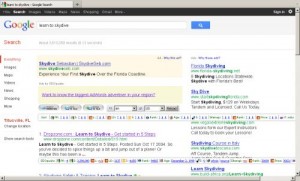
Google ads are also found on the “niche” websites of people who are part of the AdWords network, trying to make money using Google’s AdSense ads on their site.
The results page for the search term “learn to skydive” shows several skydiving websites which all feature various AdSense advertisements on “skydiving”.
As you can see in the following screenshot; Dropzone.com has PPC ads in the right column for “Florida Skydiving”, “Skydive Sebastian”, “Texas Skydiving” and “Skydiving In Virginia”.
These ad spaces link directly to the retailer who purchased each individual advertisement.
As you can see, in an effort to increase sales, all of these online marketers are using Google’s PPC AdWords advertisements to drive targeted traffic to their websites.

Now, think about the potential sales you would generate, if you could just purchase the Dropzone.com website, along with the targeted AdSense ads that link to each of the retailers.
This is the general idea behind purchasing a website to drive web traffic.
If you decide to go this route, there are several ways to find good niche websites to purchase that are already driving traffic to their retailers.
When merchants use PPC advertising, the referring sites are part of Google’s AdWords network and can be found using Google Analytics.
Once you find a site that matches your needs, contact the site owner to see if it is available for purchase.
You can also use the search engines to find sites that match the specific keywords you are interested in.
Sites that appear high in the organic search results are the ones you should concentrate on.
If you perform a Google search for “websites for sale” or “website marketplaces”, the search will hook you up with a ton of websites such as the ones below, that list sites for sale :
Flippa
Latona’s
digble
WebsiteBroker.com
Webmasters Marketplace
BuyMySite
BusinessBroker.net
Second Wind Marketplace
Before you decide to buy any website, always make sure you thoroughly check it out.
Although purchasing a website to drive web traffic can provide you with an additional source of targeted traffic and income, it can also be a risky proposition if you don’t do your due diligence.


